Pages

Showing posts with label Healthcare IT experiment. Show all posts

Wednesday, July 21, 2010

The National Program for Healthcare IT in the U.S., and the Elephant in the Living Room

The National Institute of Standards and Technology (NIST) has begun to address deficient clinical IT usability. A PDF with presentations on the topic from the recent NIST conference on HIT usability is here (warning: very large, 26 MB).

There is a critical "meta-issue" that's being ignored regarding usability, though, yet it is the elephant in the living room.

First, I will detail the elephant, then ask the simple, logical question that arises (the "inconvenient" question that nobody seems to be able to give a straight, non-marketing-spin answer to).

Here are the details of the elephant.

First, poor usability ---> increased risk to patients.

This is a first principle; it is not open to debate.

Now:

If NIST is just now getting involved in "improving HIT usability" (the improvement of which should have occurred at least two decades ago);

While HIMSS's former Chairman of the Board admits the technology remains experimental:
... We’re still learning, in healthcare, about that user interface. We’re still learning about how to put the applications together in a clinical workflow that’s going to be valuable to the patients and to the people who are providing care. Let’s be patient. Let’s give them a chance to figure out the right way to do this. Let’s give the application providers an opportunity to make this better;

While HIMSS itself admits in this 2009 PDF that

"Electronic medical record (EMR)!adoption rates have been slower than expected in the United States, especially in comparison to other industry sectors and other developed countries. A key reason, aside from initial costs and lost productivity during EMR implementation, is lack of efficiency and usability of EMRs currently available";

While the National Research Council (the highest scientific authority in the U.S.) last year reported that :

"Current Approaches to U.S. Health Care Information Technology are Insufficient" and that the technology "does not support clinicians' cognitive needs." The study was chaired by Medical Informatics pioneers Octo Barnett (Harvard/MGH) and William Stead (Vanderbilt);

While it's not just the user experience that's the problem, either...

Insurers are starting to recognize this, e.g., "NORCAL Mutual Insurance Company: "Electronic Health Records: Recognizing and Managing the Risks" ;

While hospitals and vendors cannot yet manage the technology reliably - how many medical mistakes have/will occur as a result of screw ups like this one, now confirmed to have occurred at a religious-denomination hospital chain headquartered in the Great Lakes region of the U.S.?


This patient won't get a second chance, either.

The above issues are the elephant in the living room. Or, shall I say, in the Boardrooms and meeting rooms where health IT is planned and discussed?
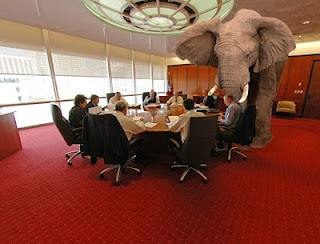

Health IT is great stuff, guys; it might actually work well one day!
Let's roll it out nationally and penalize those Luddite doctors
who refuse to "use it meaningfully" because it's not very usable.
Oh, just ignore that strange creature over there in the corner .
..


Considering the size and weight of the elephant, here is my question:

Why are we rolling out this technology nationally under penalty of Medicare garnishment?

I cannot get a straight, unspun answer to that question.

Perhaps we need Bill O'Reilly to ask these questions of health IT officials on his FOX News program, The O'Reilly Factor, where spin is attacked relentlessly (the "No Spin Zone.")

-- SS

Tuesday, July 20, 2010

Barry Chaiken, MD, MPH: "Let's be patient" with experimental devices that harm patients

At an interview of Barry Chaiken, MD, MPH, FHIMSS, former Chairman of the Board of health IT trade group HIMSS and chief medical officer of Imprivata, a company specializing in healthcare IT security, Chaiken pleads for the following special accommodations for Health IT relative to other medical sectors:

... We’re still learning, in healthcare, about that user interface. We’re still learning about how to put the applications together in a clinical workflow that’s going to be valuable to the patients and to the people who are providing care. Let’s be patient. Let’s give them a chance to figure out the right way to do this. Let’s give the application providers an opportunity to make this better.

[Why are the health IT applications bad to begin with, I ask? - ed.]

I note the following.

  • If 'we're' still learning (and I don't include people with genuine clinical computing expertise in that subgroup, but it does include the plethora of amateurs in the commercial health IT industry), then the technology is experimental.
  • Worse, it's unregulated - a major special accommodation in and of itself.
  • These sentiments about "being patient" would be appropriate - if the subjects of this experimental technology that vendors need to be "given a chance" to make better were experimental lab rats.

Instead, the subjects of the experimental technology are unwitting, unconsenting human beings, who are being used as experimental test subjects for software development, and being put at risk, injured and indeed killed by the disruptions these experimental technologies cause.

Under these realities, the position presented by Chaiken is, in my opinion, ethically perverse.

That such sentiments come from someone who holds the MD degree and who I assume took the Hippocratic oath in some form is stunning.

In the health IT industry, "Primum non nocere" seems to have been replaced with "Kybernetik über alle."

Further, the commercial health IT vendors have had the good part of five decades to "get it right." How long is long enough?

Their software is unavailable for detailed evaluation and open critique of the user experience by impartial experts, unlike open source EHR's like VistA CPRS, demo version available at this link where anyone can:

  • Download the latest version of CPRS today and get access to new features including graphing functionality
  • Use the software as if you were a provider by entering orders, entering documentation, retrieving reports (and graphs) and viewing alerts and notifications that help with decision support
  • Learn first hand how VA’s electronic health record system works

Personally, I've had to use stealth simply to obtain and post graphical representations of some simply inexcusable commercial HIT interface sins (link). Why should a secretive industry be given additional special accommodation?

Dr. Chaiken goes on to state:

Let’s hold them accountable if they don’t [make the applications better]. Absolutely, hold them accountable if they don’t; and the marketplace, I hope, will be able to make those choices and hold them accountable when they don’t. But, we’re still learning.

Again, I'm not sure who the "we're" refers to, but "holding companies accountable" will not really help victims of the experiments who are seriously injured or killed.

A better solution, as I have written on this blog (such as at my Nov. 2008 post "Should The U.S. Call A Moratorium On Ambitious National Electronic Health Records Plans?" and at other sites as well:

Protect patients. Constrain the health IT experiment temporally and geographically, and apply the laws, customs and regulations of medical experimentation until this industry "has learned" whatever lessons Chaiken thinks they need to learn, e.g., from decades of Medical Informatics, Social Informatics, Computer Science, HCI and other research. None of these fields - last time I looked - are classified or protected intellectual property. Share information on patient adverse outcomes and near misses, instead of concealing them and contractually gagging users from openly speaking about problems.

That would be the ethical approach.

Further, how many more decades should we wait for the health IT industry to figure out how to look for better leaders beyond the "school of hard knocks" bias that's existed for at least the past decade? How many substandard health IT leaders were placed in hospitals the past few decades as a result of outrageous attitudes like these below from the major recrutiers, centered on spreading the wealth?

I don't think a degree gets you anything," says healthcare recruiter Lion Goodman, president of the Goodman Group in San Rafael, California about CIO's and other healthcare MIS staffers. Healthcare MIS recruiter Betsy Hersher of Hersher Associates, Northbrook, Illinois, agreed, stating "There's nothing like the school of hard knocks." In seeking out CIO talent, recruiter Lion Goodman "doesn't think clinical experience yields [hospital] IT people who have broad enough perspective. Physicians in particular make poor choices for CIOs. They don't think of the business issues at hand because they're consumed with patient care issues," according to Goodman. Healthcare Informatics, "Who's Growing CIO's."

[No, that line about 'being consumed with patient care issues' as a strike against health IT leadership didn't come from a Scott Adams business-idiot parody cartoon - ed.]

As in clinical medicine itself, if you're going to be anywhere near patient care and making decisions affecting its delivery, a degree damn well "gets you something."

At about the same time the above appeared in Healthcare Informatics, a generalist IT recruiter wrote me this:

... What is happening to MDs trying to change careers is providing a window into broader issues about professionals in society today - narrow training, pigeonholing in the marketplace, difficulty making lateral and cross-industry transition, what a handicap it is to be creative, entrepreneurial, or cross-disciplinary in the current marketplace, and the wasted intellectual capital represented by the high caliber of individuals who can't find ways to fruitfully plug themselves into the marketplace.

I continue to be amazed at this general phenomenon...the remarkable quality of a number of candidates I've met, and the lack of recruiters' ability to get them in the door of good companies. The interesting part of the story is that when I am able to get access to high level execs in some of these companies (not just IT, but devices, pharmaceuticals, etc. also) they are dismayed at the quality of those that they hire. They know that something is wrong in how the recruitment process is working. (eg, one of the major device cos. just devoted the time of 1 FTE in Human Resources to 'finding innovative ways of identifying and recruiting good talent into the company.')

Whose fault were the outrageous, deleterious hiring practices prevalent in this industry that contributed materially to its production of substandard products, hiring practices that persist to this day? (See example here.)

Why should we be "patient", and "give them [yet more chances] to figure out the right way to do this", and why should patients permit themselves to continue to be guinea pigs to such a sloppy, cavalier industry?

I note that Chaiken's credentials appear to fit the template, as colleague Roy Poses describes at various posts including here, of an "executive isolated from the real world of health care" and member of the superclass. From the interview linked above:

... According to your LinkedIn profile, you’re CMO for Imprivata, CMIO for Symphony Corporation, and CMO of DocsNetwork. You’re on a couple of advisory boards, you own a vineyard, and you just finished your term as chair of the HIMSS board.

Perhaps that helps explain the mantra of "computers [and profit] first, patients second."

Finally, in answer to my own question above "Why are the health IT applications bad to begin with", I suggest complacency, incompetence, willful ignorance, and negligence (including criminal negligence) as possible answers.

-- SS

Addendum:

The following in today's WSJ caught my eye ("What we've learned from the Gulf spill", Michio Kaku, July 20, 2010):

The nagging question is: Why did it take so long? Why couldn't they have capped the leak months ago? For three agonizing months, BP's engineers and executives were essentially making things up as they went along, conducting a billion dollar science project with the American people as guinea pigs. The basic science of stopping oil leaks at 5,000 feet below sea level should have been done years ago.

Concepts are similar. With just a few edits, we have this:

The nagging question is: Why is it taking so long? Why couldn't they have learned to create useful health IT decades ago? For at least thirty agonizing years, Health IT vendors' engineers and executives were essentially making things up as they went along, conducting a multibillion dollar science project with the American people as guinea pigs. The basic science of producing safe, effective, usable health IT should have been done years ago.

-- SS

Wednesday, April 21, 2010

A Short, Pithy, Open Letter to the National Coordinator for Health IT Dr. David Blumenthal

Sent: Wednesday, April 21, 2010 7:17 AM
To: David.Blumenthal@hhs.gov
Cc: fschulte@huffpostfund.org; 'Ross Koppel'; 'Justin Starren'
Subject: Re: "As Doctors Shift to Electronic Health Systems, Signs of Harm Emerge"

Dear Dr. Blumenthal,

In the Apr. 20, 2010 article "As Doctors Shift to Electronic Health Systems, Signs of Harm Emerge" at http://huffpostfund.org/stories/2010/04/doctors-shift-electronic-health-systems-signs-harm-emerge#ixzz0ljMzNOzD you are quoted as saying that:

"... CPOE alert and decision support features make doctors better ... CPOE is critical to the success of the electronic health records initiative. We need to support it and make sure it happens. How fast and in what form remains to be seen."


I have written that our approaches to IT in medicine lack the scientific approach we use in medicine itself. The foundation of that approach is the use of evidence.


Yet the evidence base is increasingly shedding doubt on statements such as yours, including studies and articles I've been compiling at http://www.ischool.drexel.edu/faculty/ssilverstein/failurecases/?loc=cases&sloc=2009 . This growing corpus of literature suggests these statements may be premature regarding the health IT experiment.


I also share a belief that HIT potentially holds great promise towards improving healthcare quality, safety and costs. However, my beliefs are based on my experiences developing such technology for highly specialized clinical settings, but specifically not based on my experiences with commercial HIT upon which your office is leading a multi-billion dollar spending frenzy. My experiences with that sector have been disappointing as I have repeatedly documented at the Healthcare Renewal blog of the Foundation for Integrity and Responsibility in Medicine.


As we enter the second decade of the 21st century this potential has been largely unrealized. Significant factors impeding HIT achievement have been false assumptions concerning the challenges presented by this still-experimental technology, underestimations of the expertise essential to achieve the potential benefits of HIT, and the current orthodoxies around leadership for this grand social reengineering experiment.


The enabler and driver of these factors has been a lack of critical thinking about the technology, about social informatics and its implications, and a marketing and HIMSS driven 'irrational exuberance.'


We really need to return to critical thinking and to a scientific approach to our evaluations and prognostications about HIT.


With that in mind, please show us the hard evidence, now, that would support such statements, or please stop making statements to an unwitting medical audience and public that "CPOE is critical to the success of the electronic health records initiative."


Such statements sound more and more like marketing, not the measured statements on experimental technology I would expect to hear from a Harvard physician-scientist.


-- SS

Friday, April 16, 2010

Health Information Technology Basics From Calif. Nurses Association and National Nurses Organizing Committee

I have never before seen a document like the one entitled "Health Information Technology Basics", by the Institute for Health & Socio-Economic Policy, California Nurses Association and the National Nurses Organizing Committee. It is available at this link (PDF).

It is long but contains rather interesting views on the issue of health IT, management and clinicians (nurses).

I find the following passages of particular interest as they reflect views we express on this blog, and attack the notion of cybernetic miracles being wrought:

Skill is the ability, drawn from education and experience, to do something expertly. It can also be defined as the effective exercise of professional judgment in non-routine situations.

Following prescribed rules, as a machine would, makes an employee competent to perform tasks, but it doesn’t make the employee skilled. They can do their job as long as there are no surprises. But when something unexpected happens, the rules break down, and caring for patients means facing the unexpected every day. Only skilled health professionals can cope with the unexpected. To know what to do, they have to rely on their own judgment. The exercise of judgment is the essence of skill.

... Much health information technology is skill-degrading. As the work of health professionals becomes increasingly automated, they lose the ability to do their jobs without HIT. To make matters worse, they’re expected to keep pace with machines. They serve the machines rather than doing the more gratifying work of patient care, and ultimately they’re compensated less well.

And this:

Displacement [pf people by machines] is hard to spot because it’s unlikely to appear as a one-to one correspondence; that is, you probably won’t find a robot sitting in your colleague’s chair tomorrow. It’s more likely to happen piecemeal, over an extended period, and through attrition.

  • The job of patient care will be redefined, privileging technical over clinical skills.
  • The hospital will begin to hire more HIT specialists and fewer RNs.
  • Functions performed in the past by health professionals will be fragmented and reallocated between machines and less-skilled employees.
  • Increased technical efficiency will enable the hospital or HMO to expand without expanding its workforce.

And this:

Use of any hospital technology must be consistent with safe, therapeutic, and effective patient care. Health information technology is a complete unknown in this regard. It’s an enormous social experiment designed by computer scientists and implemented by hospital administrators. HIT hasn’t grown organically from the needs of patients but has been imported from other industries. Known as enterprise resource planning, it’s adapted from similar technology designed to manage business operations on a massive scale and already being used to run the world’s largest corporations.

Caring for patients isn’t business. It requires compassion, judgment, and advocacy. Because RNs have the moral right and legal duty to advocate for patients, they have to be able to override the automated decision-making of HIT designed to serve business interests.

RNs have to work collectively to control health information technology rather than trying to fix it. It’s important to recognize that tinkering can’t fix HIT because its primary purpose is to mechanize, or routinize, patient care. It’s designed to quantify the unquantifiable, to replace the patient with an imaginary statistical norm. High-quality healthcare can’t be mechanized because it depends on people—on patients and caregivers—and people are infinitely more complex and capable than computers can ever be.

Amen to that.

Read the entire document for a union-oriented view of health IT. It contains many truisms regarding HIT irrational exuberance and the control issues of the healthcare management class.

-- SS

Tuesday, April 13, 2010

Yet Another Study Shows Health IT Does Not Bat The Ball Out of the Park; And, is HIT an Issue of States' Rights?

At "2009 a Pivotal Year in Health IT" I aggregated a number of reports and articles from that year shedding needed critical light on the irrational exuberance surrounding computers in medicine, an exuberance that seems to consider clinical professionals with years of hard training and expertise as simpletons who should bow to the cybernetic miracles created by the health IT cartel.

The critical reviews continue in 2010. Here's another in Health Affairs from a team at Harvard: Electronic Health Records' Limited Successes Suggest More Targeted Uses. The team, led by Harvard Medical School professor Catherine M. DesRoches, surveyed more than 3,000 U.S. community hospitals to assess factors such as inpatient costs and mortality and readmission rates.

Here were their findings:

Understanding whether electronic health records, as currently adopted, improve quality and efficiency has important implications for how best to employ the estimated $20 billion in health information technology incentives authorized by the American Recovery and Reinvestment Act of 2009. We examined electronic health record adoption in U.S. hospitals and the relationship to quality and efficiency. Across a large number of metrics examined, the relationships were modest at best and generally lacked statistical or clinical significance. However, the presence of clinical decision support was associated with small quality gains. Our findings suggest that to drive substantial gains in quality and efficiency, simply adopting electronic health records is likely to be insufficient. Instead, policies are needed that encourage the use of electronic health records in ways that will lead to improvements in care.

On that last point, I disagree; it's not the use of HIT that needs to be encouraged, it's the remediation of HIT that needs to be encouraged/enforced to make HIT useful. More below.

The authors also report:

Hospitals with comprehensive electronic health record systems were compared with those with no or basic electronic systems, and the team only found slight differences in areas such as length of stay and surgical infection prevention.

Overall, the researchers determined that the technological systems, as currently implemented, do not have a significant impact on improving care and reducing costs, DesRoches said.

“Having a system is not enough,” DesRoches added. “We can’t expect that hospitals are just going to plug these systems in, and suddenly you’re going to see large improvements. [Not according to our President and the heads of HHS and ONC, who've explicitly stated that health IT will produce all sorts of technologically deterministic miracles - ed.] The systems are only going to be as good as how people are using them.”


I would differ from the authors on the last point, that "the systems are only going to be as good as how people are using them.” The authors seem to assume that health IT is a perfected technology.

I would say that "the results are only going to be as good as the systems clinicians are forced to use."

If the systems are crap, then the results of their use will be crap.

The authors concluded that "the study’s findings should not deter future technological advances in keeping medical records.


In fact, I think with results such as these, improving health IT through technological advancement is an absolute imperative. To do so, however, will require major advances in the health IT industry itself - its methodologies for health IT development and validation, its qualifications for leadership, and its regulation.

“With the amount of attention and money that the federal government is putting into this issue, I don’t think we can do anything but move forward at this point,” Desroches said.

Again, I disagree with the author's white-flagged surrender to the diktats of the Federal Government. The Federal takeover of health IT via the establishment on ONC by HHS made me uncomfortable when it occurred in 2004, and it is increasingly clear why.

When serious doubts are thrown on a technology being pushed on a critical profession and a nation's critical services, the imperative should be on slowing down and fixing the problems before spending hundreds of billions more dollars in a massive federal push, a push that even includes federal coercion in the form of Medicare penalties for non-adopters.

As studies like this show, HIT medical devices are experimental, yet increasingly serve as governors of medical care. They are "governors by cybernetic proxy", I might add. These devices put the federal government, and the health IT vendors as well, with their "best practices" criteria, directly in the exam room. This is done without true patient informed consent.

The rights to govern the practice of medicine reside with the states, not the Federal government. (Drug and device safety were made an exception via FDA regulation, but health IT is entirely unregulated, demonstrating incompetence at best on the part of the federal government in a matter critical to healthcare).

Perhaps the states need to take up the issue of federal pressure to implement experimental health IT. Health IT is technology that seeks to govern the practice of medicine but does not seem to have significant ROI the way it is designed and implemented today. It does, however, have a definite but unknown incidence of harm (the FDA's data on patient injury and death attributed to bad IT are suspected to be just the "tip of the iceberg" according to the FDA itself). Perhaps states' rights need to be invoked in order to slow the out-of-control, federally fueled locomotive.

It seems that federal imperatives to:

  • coerce clinicians to purchase experimental products of commercial health IT companies under duress of federal penalty (much as consumers are going to be forced to purchase health insurance from commercial insurance companies under threat of penalty, although at least those products are not experimental);
  • determine"meaningful use" criteria;
  • determine who can "certify" the technology;
  • set up federal "Regional Extension Centers" (REC's) and a national Health Information Technology Research Center (HITRC);
and the HITECH act itself represent a huge power grab that tramples states' rights to regulate the practice of medicine.

-- SS

Friday, March 26, 2010

Hospitals Under the Knife: Sacrificing Hospital Jobs for the Extravagance of Healthcare IT?

A WSJ article on the financial condition of NY hospitals, and specifically a line by NY Mayor Bloomberg, caught my eye:

Wall Street Journal
Mar. 26, 2010
Hospitals Under the Knife
New York City System Aims to Cut 2,600 More Jobs as State Funding Drops
By MICHAEL HOWARD SAUL and SUZANNE SATALINE

NEW YORK—The nation's largest public hospital system plans to slash its work force—including doctors and nurses—by about 10% over two years as government aid drops and the number of uninsured patients jumps.

With its budget deficit set to top $1 billion, New York City's Health and Hospitals Corp. plans to eliminate 2,600 jobs in the fiscal year that begins July 1. That comes on top of 1,300 positions to be eliminated this year."No hospital system in the country is exempt from the crushing economics facing the health-care industry," said New York Mayor Michael Bloomberg. He noted that New York had been early to adopt electronic medical records but said that state budget cuts were hitting the system hard.

...
Previous job cuts focused on trimming support staff, but the new measures will include physicians and nurses, Alan Aviles, the corporation's president, said in an interview.

"Early to adopt EMR's BUT the budget cuts were hitting the system hard?"

To the knowledgeable, this seems a non sequitur. Its message is clearly that yes, we spent hundreds of millions of dollars on EMR's, but the adoption of EMR's should have saved us jillions of dollars, helping insulate us from economic downturns.

Yet some very serious researchers say this is not the case.

For starters, there's, Ashish Jha’s research at the Harvard School of Public Health that compared 3,000 hospitals at various stages in the adoption of computerized health records and found little difference in the cost and quality of care. A New York Times story "Little Benefit Seen, So Far, in Electronic Patient Records" on those findings is here. Was anyone in the Governor's office or hospital governance reading their own newspaper?

Then, there's the Nov. 2009 “Hospital Computing and the Costs and Quality of Care: A National Study” (Amer J Med 123:1; 40-46) by Himmelstein and Wololhandler at Harvard Medical School, that also concluded “as currently implemented, hospital computing might [very] modestly improve process measures of quality but not administrative or overall costs."

There's the June 2009 Wharton School of Business article "Information Technology: Not a Cure for the High Cost of Health Care" that I wrote about at this HC Renewal post. Senior Wharton professors wrote:

Technology could increase health care costs without markedly improving quality, according to experts at Wharton.

... "
No one has done the careful research to indicate that if one health care system has information technology and the other doesn't, then the care is different. There are no controlled trials," says Mark Pauly, a health care management professor at Wharton. All that technology is no panacea, he warns. In fact, he believes IT could actually raise costs because of culture clashes, training, the implementation of the systems [I would say "the mayhem that often goes on during the implementation" - ed.] and the labor required to maintain the new technology.

"The best-case scenario is that information technology will improve quality but not lower costs. The worst case is that there's no difference at all."


... That opinion is echoed by other experts at Wharton and the University of Pennsylvania. "The focus on IT in health care is a good thing, but there's
way too much hype about it and misunderstanding about what the benefits will be and how quickly they will come," says Peter Gabriel, medical director of clinical information systems at the University of Pennsylvania Health System.

[
Kevin Volpp, professor of medicine and health care management] agrees that tracking real cost savings from health care IT is a difficult task, but he expects there to be some benefits from spotting and eliminating redundant care. But those benefits aren't likely to add up to big savings, says Lawton R. Burns, director of the Wharton Center for Health Management and Economics. "I agree that information technology is important, but it's not the slam dunk it's portrayed to be," he says. The chase to reduce costs, improve quality and expand coverage is deemed the "iron triangle of health care. A lot of us wince [at that goal]," Burns notes. "It's arguable that we can't do any of those things well."

David A. Asch, a Wharton health care management and economics professor, agrees that technology is a big part of reform. "No one is arguing against it, but that doesn't mean that it's not oversold," he says. Gabriel likens the fascination over IT in health care to a shiny new object that's easier to focus on relative to more daunting issues.

... In addition, it's unclear what
cultural issues [a big theme in my writings - ed.] will emerge as information technology is adopted. These cultural issues are in the forefront of primary care physician relationships. Experts at Wharton and Penn say physicians are generally skeptical of the technology movement. How much will a technology overhaul add to operating costs? How much will it cost to retrain workers? What's the electronic record learning curve? And what happens when a doctor has a laptop between him and the patient?

"
Individual physicians just don't know where the money is going to come from," says Pauly. "If IT is tied to reimbursements it could work, but [many] are skeptical." Burns adds that the physician-patient relationship can also be altered. "Technology adoption changes the way you practice. What happens when your primary care physician is looking at his screen instead of you?"


There are the concerns of Abraham Verghese, Professor and Senior Associate Chair for the Theory and Practice of Medicine at Stanford, who wrote in the Wall Street Journal in a June 2009 article "The Myth of Prevention" that:

... I have similar problems with the way President Obama hopes to pay for the huge and costly health reform package he has in mind that will cover all Americans; he is counting on the “savings” that will come as a result of investing in preventive care and investing in the electronic medical record among other things. It’s a dangerous and probably an incorrect projection.

Finally, this is an experimental technology whose benefits and risks are not well known.

In the article "Electronic Health Record Use and the Quality of Ambulatory Care in the United States" (Arch Intern Med. 2007;167:1400-1405), the authors examined electronic medical records use throughout the U.S. and the association of EMR use with 17 basic quality indicators. They concluded that “as implemented, EMRs were not associated with better quality ambulatory care.”

Further, the FDA recently testified that this technology can actually harm and kill patients, but the extent is unknown. Existing FDA data is likely the "tip of the iceberg", testified FDA official Jeffrey Shuren MD, JD at the HIT Policy Committee, Adoption/Certification Workgroup, special meeting on health IT safety on February 25, 2010.

I described Shuren's testimony in my HC Renewal post "FDA on Health IT Adverse Consequences: 44 Reported Injuries And 6 Deaths, Probably Just 'Tip of Iceberg'." Considering FDA is nearly unknown as the go-to for such reports, and the low reporting of medical errors related to computing noted by Koppel at the same meeting, the actual rates of injury and death could be much, much larger.

In effect, NY hospital physicians, nurses and support staff will lose their job due to budget shortfalls, at the same time the NY hospitals have been spending hundreds of millions of dollars on the extravagance of experimental clinical IT systems whose benefit is still an unknown.

Perhaps some of those millions could have been better spent on human beings, such as employees or better yet, patient care.

As I've written before, the health IT industry seems to be staging an invasion of healthcare to its own benefit. Now, clinical personnel are losing their jobs as a result, and patient care is likely to suffer.

While I'm supportive of EMR experimentation when finances are stable (when performed with patient safety considerations as paramount, of course), this is not the time for such extravagance in NY, especially when jobs - both support and clinical - are threatened.

Irrational exuberance in technology is bad enough - it's far worse when you can't afford the objects of your affection.

One suggestion is that the healthcare IT experiments be put on hold as unaffordable under current conditions, and resumed when finances are more stable. The money could be diverted to keeping physicians, nurses and support staff employed. The risks could also be studied further. However, this might cause some executives somewhere to have to forgo their pet contracts with their friendly HIT vendors and management consultant companies.

Computers are more important than people, after all.

At a time of massive international economic difficulty, "Blood for Computers!" can be the new rallying cry.

Since many of the layoffs will involve union members of District Council 37, the city's largest municipal employee union, perhaps the rallying cry "Computers for Union Busting!" could also apply.

(Some people would have no problems with that, but these are real, live hospital staff being put out of work, and the patients they care for being affected.)

-- SS

3/26/10 Addendum:

The advice above may apply to an entire country, the UK, that seems to have spent about £13 billion (about $19 billion U.S.) on health IT that doesn't work.

Per the Telegraph article today "Hospital wards to shut in secret NHS cuts":

Tens of thousands of NHS workers would be sacked, hospital units closed and patients denied treatments under secret plans for £20 billion of health cuts.

... The proposals could lead to:

  • 10 per cent of NHS staff being sacked in some areas.
  • The loss of thousands of hospital beds.
  • A reduction in the number of ambulance call-outs.
  • Medical professionals being replaced by less qualified assistants.

At least the IT industry is alive and well.

-- SS

Hospitals Under the Knife: Sacrificing Hospital Jobs for the Extravagance of Healthcare IT?

A WSJ article on the financial condition of NY hospitals, and specifically a line by NY Mayor Bloomberg, caught my eye:

Wall Street Journal
Mar. 26, 2010
Hospitals Under the Knife
New York City System Aims to Cut 2,600 More Jobs as State Funding Drops
By MICHAEL HOWARD SAUL and SUZANNE SATALINE

NEW YORK—The nation's largest public hospital system plans to slash its work force—including doctors and nurses—by about 10% over two years as government aid drops and the number of uninsured patients jumps.

With its budget deficit set to top $1 billion, New York City's Health and Hospitals Corp. plans to eliminate 2,600 jobs in the fiscal year that begins July 1. That comes on top of 1,300 positions to be eliminated this year."No hospital system in the country is exempt from the crushing economics facing the health-care industry," said New York Mayor Michael Bloomberg. He noted that New York had been early to adopt electronic medical records but said that state budget cuts were hitting the system hard.

...
Previous job cuts focused on trimming support staff, but the new measures will include physicians and nurses, Alan Aviles, the corporation's president, said in an interview.

"Early to adopt EMR's BUT the budget cuts were hitting the system hard?"

To the knowledgeable, this seems a non sequitur. Its message is clearly that yes, we spent hundreds of millions of dollars on EMR's, but the adoption of EMR's should have saved us jillions of dollars, helping insulate us from economic downturns.

Yet some very serious researchers say this is not the case.

For starters, there's, Ashish Jha’s research at the Harvard School of Public Health that compared 3,000 hospitals at various stages in the adoption of computerized health records and found little difference in the cost and quality of care. A New York Times story "Little Benefit Seen, So Far, in Electronic Patient Records" on those findings is here. Was anyone in the Governor's office or hospital governance reading their own newspaper?

Then, there's the Nov. 2009 “Hospital Computing and the Costs and Quality of Care: A National Study” (Amer J Med 123:1; 40-46) by Himmelstein and Wololhandler at Harvard Medical School, that also concluded “as currently implemented, hospital computing might [very] modestly improve process measures of quality but not administrative or overall costs."

There's the June 2009 Wharton School of Business article "Information Technology: Not a Cure for the High Cost of Health Care" that I wrote about at this HC Renewal post. Senior Wharton professors wrote:

Technology could increase health care costs without markedly improving quality, according to experts at Wharton.

... "
No one has done the careful research to indicate that if one health care system has information technology and the other doesn't, then the care is different. There are no controlled trials," says Mark Pauly, a health care management professor at Wharton. All that technology is no panacea, he warns. In fact, he believes IT could actually raise costs because of culture clashes, training, the implementation of the systems [I would say "the mayhem that often goes on during the implementation" - ed.] and the labor required to maintain the new technology.

"The best-case scenario is that information technology will improve quality but not lower costs. The worst case is that there's no difference at all."


... That opinion is echoed by other experts at Wharton and the University of Pennsylvania. "The focus on IT in health care is a good thing, but there's
way too much hype about it and misunderstanding about what the benefits will be and how quickly they will come," says Peter Gabriel, medical director of clinical information systems at the University of Pennsylvania Health System.

[
Kevin Volpp, professor of medicine and health care management] agrees that tracking real cost savings from health care IT is a difficult task, but he expects there to be some benefits from spotting and eliminating redundant care. But those benefits aren't likely to add up to big savings, says Lawton R. Burns, director of the Wharton Center for Health Management and Economics. "I agree that information technology is important, but it's not the slam dunk it's portrayed to be," he says. The chase to reduce costs, improve quality and expand coverage is deemed the "iron triangle of health care. A lot of us wince [at that goal]," Burns notes. "It's arguable that we can't do any of those things well."

David A. Asch, a Wharton health care management and economics professor, agrees that technology is a big part of reform. "No one is arguing against it, but that doesn't mean that it's not oversold," he says. Gabriel likens the fascination over IT in health care to a shiny new object that's easier to focus on relative to more daunting issues.

... In addition, it's unclear what
cultural issues [a big theme in my writings - ed.] will emerge as information technology is adopted. These cultural issues are in the forefront of primary care physician relationships. Experts at Wharton and Penn say physicians are generally skeptical of the technology movement. How much will a technology overhaul add to operating costs? How much will it cost to retrain workers? What's the electronic record learning curve? And what happens when a doctor has a laptop between him and the patient?

"
Individual physicians just don't know where the money is going to come from," says Pauly. "If IT is tied to reimbursements it could work, but [many] are skeptical." Burns adds that the physician-patient relationship can also be altered. "Technology adoption changes the way you practice. What happens when your primary care physician is looking at his screen instead of you?"


There are the concerns of Abraham Verghese, Professor and Senior Associate Chair for the Theory and Practice of Medicine at Stanford, who wrote in the Wall Street Journal in a June 2009 article "The Myth of Prevention" that:

... I have similar problems with the way President Obama hopes to pay for the huge and costly health reform package he has in mind that will cover all Americans; he is counting on the “savings” that will come as a result of investing in preventive care and investing in the electronic medical record among other things. It’s a dangerous and probably an incorrect projection.

Finally, this is an experimental technology whose benefits and risks are not well known.

In the article "Electronic Health Record Use and the Quality of Ambulatory Care in the United States" (Arch Intern Med. 2007;167:1400-1405), the authors examined electronic medical records use throughout the U.S. and the association of EMR use with 17 basic quality indicators. They concluded that “as implemented, EMRs were not associated with better quality ambulatory care.”

Further, the FDA recently testified that this technology can actually harm and kill patients, but the extent is unknown. Existing FDA data is likely the "tip of the iceberg", testified FDA official Jeffrey Shuren MD, JD at the HIT Policy Committee, Adoption/Certification Workgroup, special meeting on health IT safety on February 25, 2010.

I described Shuren's testimony in my HC Renewal post "FDA on Health IT Adverse Consequences: 44 Reported Injuries And 6 Deaths, Probably Just 'Tip of Iceberg'." Considering FDA is nearly unknown as the go-to for such reports, and the low reporting of medical errors related to computing noted by Koppel at the same meeting, the actual rates of injury and death could be much, much larger.

In effect, NY hospital physicians, nurses and support staff will lose their job due to budget shortfalls, at the same time the NY hospitals have been spending hundreds of millions of dollars on the extravagance of experimental clinical IT systems whose benefit is still an unknown.

Perhaps some of those millions could have been better spent on human beings, such as employees or better yet, patient care.

As I've written before, the health IT industry seems to be staging an invasion of healthcare to its own benefit. Now, clinical personnel are losing their jobs as a result, and patient care is likely to suffer.

While I'm supportive of EMR experimentation when finances are stable (when performed with patient safety considerations as paramount, of course), this is not the time for such extravagance in NY, especially when jobs - both support and clinical - are threatened.

Irrational exuberance in technology is bad enough - it's far worse when you can't afford the objects of your affection.

One suggestion is that the healthcare IT experiments be put on hold as unaffordable under current conditions, and resumed when finances are more stable. The money could be diverted to keeping physicians, nurses and support staff employed. The risks could also be studied further. However, this might cause some executives somewhere to have to forgo their pet contracts with their friendly HIT vendors and management consultant companies.

Computers are more important than people, after all.

At a time of massive international economic difficulty, "Blood for Computers!" can be the new rallying cry.

Since many of the layoffs will involve union members of District Council 37, the city's largest municipal employee union, perhaps the rallying cry "Computers for Union Busting!" could also apply.

(Some people would have no problems with that, but these are real, live hospital staff being put out of work, and the patients they care for being affected.)

-- SS

3/26/10 Addendum:

The advice above may apply to an entire country, the UK, that seems to have spent about £13 billion (about $19 billion U.S.) on health IT that doesn't work.

Per the Telegraph article today "Hospital wards to shut in secret NHS cuts":

Tens of thousands of NHS workers would be sacked, hospital units closed and patients denied treatments under secret plans for £20 billion of health cuts.

... The proposals could lead to:

  • 10 per cent of NHS staff being sacked in some areas.
  • The loss of thousands of hospital beds.
  • A reduction in the number of ambulance call-outs.
  • Medical professionals being replaced by less qualified assistants.

At least the IT industry is alive and well.

-- SS
Powered by Blogger.