Pages

Showing posts with label EPIC. Show all posts

Sunday, May 30, 2010

Did EPIC CEO Judy Faulkner of Epic declare that ‘healthcare IT usability would be part of certification over her dead body?'

At the HisTALK blog 5/31/10 update, a site with thousands of readers involved in all aspects of health IT, the following anonymous (at this point) report appeared:

From Tabula Rosa: “Re: EMR usability. At one of the ONC Policy Committee meetings, [founder and CEO] Judy Faulkner of Epic supposedly declared that ‘usability would be part of certification over her dead body.’ I wonder if she has similar sentiments about making software accessible to people with disabilities?” Unverified. This inspired my new poll question – keep reading below.

Epic Systems Corporation is one of the largest health IT vendors in the U.S.

If this report is true, it would have very, very serious implications towards the healthcare IT industry's attitudes about the usability - and ultimately the safety - of its products.

The essential nature of usability and the relationship to safety is not an issue for debate - period. It was settled long ago in relation not only to IT, but also to devices and machinery that use IT. For instance, see the mid 1980's wisdom written for the U.S. Air Force on user interfaces at my eight part series on mission hostile health IT user experiences at http://tinyurl.com/hostileuserexper. Microsoft and other responsible IT vendors spend billions on usability research.

I think it incumbent of the U.S. Office of the National Coordinator for Health IT, and its leader Dr. David Blumenthal, to confirm or deny that such a statement was made, on or off-record, at an ONC policy committee meeting, and if it was made, its exact context.

If it was made, it would raise the following questions:

  • Would its utterer be saying this out of concern that their products have usability deficiencies that competitors do not, and that are not correctable in a short time frame?
  • How much concern would such a statement indicate for the complex jobs of physicians, nurses and other clinicians whose safe conduct of their medical obligations depends on health IT?
  • How much concern would such a statement imply towards the injured and dead bodies of patients affected by health IT of deficient usability?
  • Since the CEO sets the tone for their company and has the ultimate responsibility for its conduct (and its Board of Directors as well), would such a statement reflect willful negligence and perhaps criminal conduct?

The last question is pertinent, for if, say, the CEO of Boeing were to relate that "usability of the control systems of its aircraft would be an FAA certification requirement over his or her dead body", or the CEO of oil drilling companies said same about their instrumentation that helps avoid underwater blowouts, I believe it would rise to the level of criminally negligent conduct.

This is all the more pertinent to me, as my mother was just seriously injured by a medication error that resulted from an apparent inability to move a few kilobytes of correct medication data (about which she was asked to confirm in the ED at presentation) from ED to floor. End result - a cascade of resultant complex medical problems resulting in a life-threatening 4.5 cm intracerebellar hemorrhage and emergency craniotomy. I do not know if she will survive.

I had warned this hospital's CEO and Chief of the Medical Staff - in writing - of deficiencies in its EHR systems regarding physician-physician communications a little more than one month ago, in fact, explaining that in my expert opinion, patients might get harmed.

Little did I know my own mother would be that patient a few weeks later.

I am seriously wondering, in fact, if the average hospital has the gravitas and political and technologic maturity to truly implement health IT so that the technology is uniformly beneficial, instead of spontaneously harmful, to meet the needs of the grandiose plans for national health IT.

The lack of seriousness, petty political fights, and technological dyscompetence and incompetence I have noted in my 20 years in this field do not seem surmountable in any time frame I consider "soon."

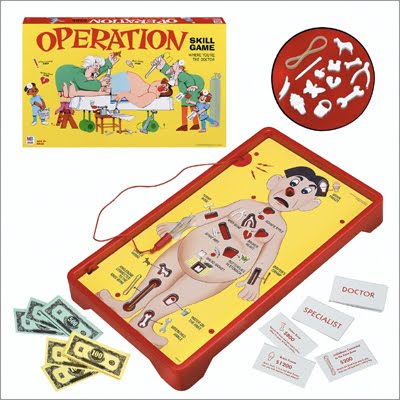
Here seems to be the health IT industry and hospital MIS department view of healthcare IT, as some sort of game to be played for profit, power and political advantage:


Here is the reality of health IT dysfunction, as my mother is now cruelly experiencing:


-- SS

Addendum May 31, 2010:

The comment thread at the bottom of HISTalk's Monday Morning Update 5/31/10 (from where the above EPIC CEO quote came) demonstrates numerous attitudes that give life to my concern that many uni-disciplinary, technology-focused HIT industry personnel may in fact be culturally and educationally unprepared, unwilling and/or unable to be collaborative, humane, safety-conscious members of the medical teams they are ostensibly hired to facilitate.

-- SS

Thursday, April 1, 2010

Epic Stupidity: Does the Award for the Most Laughable Statement Made by a Health IT Vendor Belong to EPIC?

It may, because I am hard pressed to find any statement that approaches this one in vacuousness.

Regarding reporting of healthcare IT problems and defects that might cause, or have caused, patient harm, the executive VP at EPIC stated at a HHS Health IT Policy Committee certification workgroup:

... The FDA might not be the best organization to help the ONC create an environment where people feel comfortable coming forward with incident reports, said Carl Dvorak, executive VP at EHR system provider Epic Systems and a workgroup member

Dvorak said he's also concerned that the FDA's QSR process wouldn't address problems people spoke about in recent workgroup testimony. "If the mission is to build a safer system, I don't know that the FDA can contribute toward that mission," he said.


To this I ask these questions:

1. Where, exactly, does Mr. Dvorak think clinicians and healthcare organizations report defects and problems with devices and drugs now? Consumer Reports? Good Housekeeping?

2. What is Mr. Dvorak's first hand experience with the FDA in terms of reporting on medical devices and medical device IT, and pharmaceuticals? Could that be the reason he "doesn't know" how the FDA can contribute to "the mission" of HIT medical device safety?

Perhaps Mr. Dvorak himself is uncomfortable reporting defects and problems with health IT medical devices to FDA as opposed to some new, amateur medical device safety organization [see note 1] friendly to the HIT industry or in their pockets, but clinicians won't be.

Either that, or this is one of the lamest attempt at FUD in computing history [see note 2].


A possibly real billboard from parts unknown about where to report shoddy HIT: FDA's MedWatch Hotline. (Hat tip to HisTALK blog.)

-- SS

Notes:

[1] See my post "Third-Party Reviews of Medical Devices Come Under Scrutiny at the FDA - Except Healthcare IT Medical Devices, Which Get Special Accommodation" for more on the issue of third-parties and amateurs performing device review.

[2] HIT personnel in my experience often seem to resort to a psyops strategy of trying to instill
Fear, Uncertainty and Doubt in others to kill ideas they don't like (usually, ideas that would cause them to have to work harder), although it's usually done in a far more credible manner than in this example.

Epic Stupidity: Does the Award for the Most Laughable Statement Made by a Health IT Vendor Belong to EPIC?

It may, because I am hard pressed to find any statement that approaches this one in vacuousness.

Regarding reporting of healthcare IT problems and defects that might cause, or have caused, patient harm, the executive VP at EPIC stated at a HHS Health IT Policy Committee certification workgroup:

... The FDA might not be the best organization to help the ONC create an environment where people feel comfortable coming forward with incident reports, said Carl Dvorak, executive VP at EHR system provider Epic Systems and a workgroup member

Dvorak said he's also concerned that the FDA's QSR process wouldn't address problems people spoke about in recent workgroup testimony. "If the mission is to build a safer system, I don't know that the FDA can contribute toward that mission," he said.


To this I ask these questions:

1. Where, exactly, does Mr. Dvorak think clinicians and healthcare organizations report defects and problems with devices and drugs now? Consumer Reports? Good Housekeeping?

2. What is Mr. Dvorak's first hand experience with the FDA in terms of reporting on medical devices and medical device IT, and pharmaceuticals? Could that be the reason he "doesn't know" how the FDA can contribute to "the mission" of HIT medical device safety?

Perhaps Mr. Dvorak himself is uncomfortable reporting defects and problems with health IT medical devices to FDA as opposed to some new, amateur medical device safety organization [see note 1] friendly to the HIT industry or in their pockets, but clinicians won't be.

Either that, or this is one of the lamest attempt at FUD in computing history [see note 2].


A possibly real billboard from parts unknown about where to report shoddy HIT: FDA's MedWatch Hotline. (Hat tip to HisTALK blog.)

-- SS

Notes:

[1] See my post "Third-Party Reviews of Medical Devices Come Under Scrutiny at the FDA - Except Healthcare IT Medical Devices, Which Get Special Accommodation" for more on the issue of third-parties and amateurs performing device review.

[2] HIT personnel in my experience often seem to resort to a psyops strategy of trying to instill
Fear, Uncertainty and Doubt in others to kill ideas they don't like (usually, ideas that would cause them to have to work harder), although it's usually done in a far more credible manner than in this example.
Powered by Blogger.